



 September 6, 2026
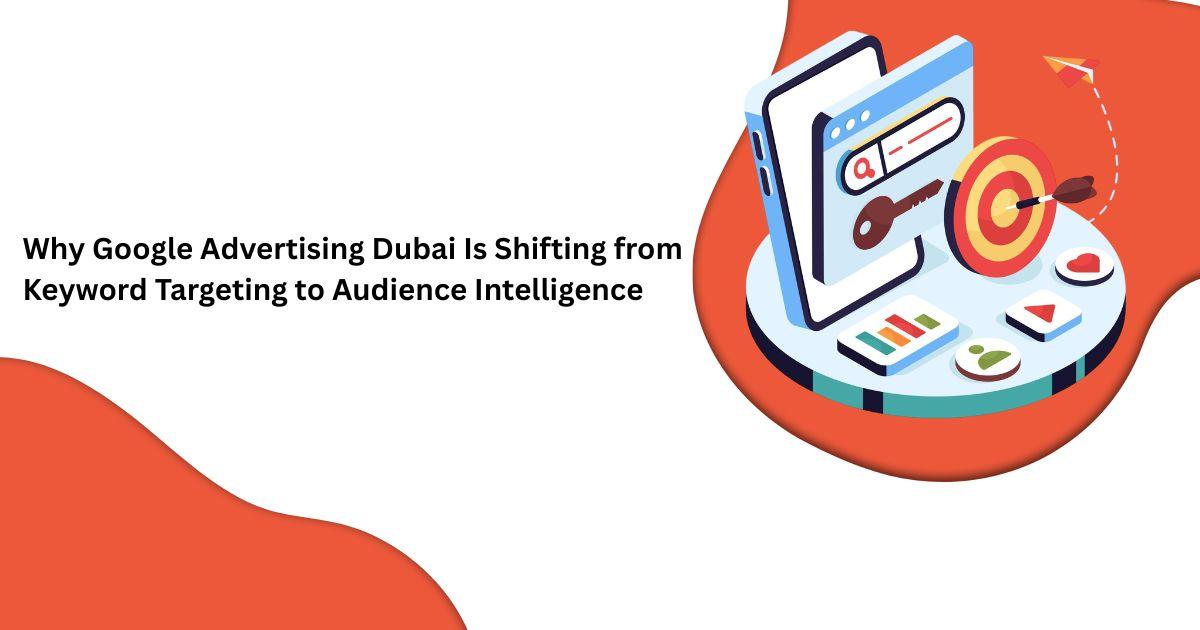
Why Google Advertising Dubai Is Shifting from Keyword Targeting to Audience Intelligence
For years, keywords were at the heart of Google Ads.
A business would identify the phrases customers were searching for, create campaigns around those terms, write relevant ads, and compete for clicks.
Simple enough.
But Google advertising has changed.
Today, Google's advertising systems can use a much wider range of signals to determine which users are more likely to take a valuable action.
Smart Bidding, for example, evaluates auction-time signals such as device, location, time, language, operating system, and other contextual information when setting bids. That means the question is gradually changing.
Instead of asking only:
“What keyword did this person search?”
Modern advertisers need to ask:
“What do we know about this person's intent, context, and likelihood to become a customer?”
This shift is particularly important for businesses investing in Google advertising Dubai, where competition for high-value searches can be intense. The future of paid search isn't simply about finding more keywords. It's about understanding audiences and intent more intelligently.
Keywords Still Matter. They Just Aren't the Whole Story.
Let's be clear. Keywords haven't disappeared.
If someone searches:
“SEO agency Dubai”, that search still provides an incredibly valuable signal. The person has expressed an interest in SEO and a geographic preference. But the keyword doesn't tell us everything.
Two people can search for exactly the same phrase and have completely different intentions. One might be researching agencies for a future project. Another may already have a budget and be ready to speak with someone today.
One could be a student researching SEO. Another could be a business owner actively looking for an agency. The keyword is identical. The people are not.
This is why modern Google Ads strategies increasingly combine keyword context with audience, behavioural, geographic, device, and other signals.
What Is Audience Intelligence?
Audience intelligence is essentially the ability to understand who your potential customers are, what they are likely to want, and which signals indicate meaningful intent. It goes beyond demographic information.
For an advertiser, useful questions might include:
- What problem is this person trying to solve?
- How close are they to making a purchase?
- What type of service are they searching for?
- Have they interacted with the brand before?
- What device are they using?
- Where are they located?
- What time are they searching?
- Which message is likely to resonate?
- What action represents real value?
Google's automated bidding systems can use a wide range of contextual signals at auction time to adjust bids based on the likelihood of conversion. That is a major change from simply thinking:
Keyword = audience.
It isn't.
Why This Matters in Dubai
Dubai is not one single audience. It's a market made up of residents, tourists, business owners, investors, professionals, international customers, high-income consumers, price-sensitive shoppers, and countless niche audiences.
Even within one industry, customer intent can vary dramatically.
Consider someone searching for:
“car rental Dubai.”
They could be:
- A tourist arriving next week
- A resident needing a temporary vehicle
- A business traveller
- Someone looking for a monthly rental
- Someone interested in a luxury vehicle
- Someone comparing prices
Same broad keyword. Very different commercial intent. A smart Google advertising Dubai strategy therefore needs to understand more than what people type into the search box. It needs to understand the context around the search.
Search Intent Is Becoming More Valuable Than Keyword Volume
For a long time, advertisers looked at keyword volume as an important indicator. The high search volume looked attractive. But volume alone doesn't pay the bills.
A keyword with 20,000 searches isn't necessarily more valuable than one with 500 searches.
The real question is:
How many of those searches represent people who are likely to become customers?
A smaller keyword with strong commercial intent can outperform a much larger informational keyword.
For example:
“what is SEO?”
may receive significant search interest.
But:
“SEO company Dubai pricing”
could indicate someone much closer to making a purchasing decision. Good advertising isn't about collecting the largest number of searches. It's about identifying the searches that matter.
Google's AI Is Making Real-Time Decisions
This is one of the biggest reasons the old way of thinking about PPC is changing. Google's Smart Bidding systems can evaluate signals at the time of each auction and adjust bids based on the likelihood of achieving a conversion or conversion value.
That means advertisers don't necessarily need to manually decide the exact bid for every possible situation. The system can react to changing conditions. For example, a user searching from one location on a particular device at a particular time may represent a different conversion opportunity from another user.
The system can account for those contextual signals. But here's the important part:
Automation is only as good as the strategy and data behind it. Giving Google more control doesn't mean giving up human judgment. It means human judgment moves to a different level.
Conversion Data Has Become Extremely Important
If Google is trying to find more users who are likely to convert, it needs to know what a valuable conversion actually looks like.
This sounds obvious. But many businesses get it wrong. They count every form submission as a conversion. They count every phone call. They count every website interaction.
But what if half those leads aren't relevant?
What if some are spam?
What if some are outside your service area?
What if one campaign produces fewer leads but generates significantly more revenue?
A good Google advertising Dubai strategy should distinguish between activity and value. The more accurately you define valuable conversions, the better your advertising data can support optimization.
First-Party Data Is Becoming More Valuable
Businesses already have information about their customers.
Website interactions.
Previous purchases.
Lead records.
Customer lists.
Past enquiries.
Repeat customers.
These sources can provide useful insight into who actually converts. Google Ads provides tools for using first-party customer data in advertising strategies, including Customer Match and audience-related features.
This creates an important opportunity. Instead of relying entirely on broad assumptions about your target market, businesses can use what they already know about their customers.
That can help advertising become more relevant. The key is responsible use of customer data and accurate measurement.
Audience Signals Don't Mean “Target Only This Audience”
This is another important distinction. Audience signals can help guide automated systems, but they don't always function like traditional rigid targeting.
Google's modern advertising products increasingly use audience information as signals that can help its systems identify people who are more likely to convert.
That creates a different mindset.
Instead of:
“Only show ads to these exact people.”
The strategy can become:
“Here are strong signals about the type of customer we're looking for. Use them intelligently while optimizing toward our business goal.”
That's a much more flexible model. And it requires advertisers to think carefully about what signals actually represent valuable customers.
Creative Is Becoming More Important
Here's the interesting part. As Google's systems become better at deciding who might respond to an ad, the quality of the message becomes even more important. If the system finds a potentially valuable customer, your ad still needs to convince them to act.
That means businesses should test:
- Headlines
- Descriptions
- Offers
- Calls to action
- Value propositions
- Images
- Video
- Landing pages
- Different customer messages
Think about it this way:
Google can help find the opportunity. Your creativity needs to make the opportunity count. A generic advertisement can waste excellent targeting. A strong message can turn a relevant impression into a valuable click.
Landing Pages Complete the Equation
Audience intelligence doesn't stop when someone clicks. The landing page determines what happens next. Imagine Google identifies someone who has a high probability of becoming a customer. The person clicks your advertisement.
Then the website:
- Loads slowly
- Looks outdated
- Doesn't match the ad
- Hides the offer
- Has confusing navigation
- Makes the contact process difficult
All that audience intelligence is wasted. That's why PPC shouldn't be managed as a separate activity from the website.
The customer journey matters:
Audience signal → Search → Ad → Landing page → Conversion → Customer
Every step affects the final result.
Location Intelligence Matters in Dubai
For businesses operating locally, geography can be a powerful signal. A customer searching from Downtown Dubai may have different needs from someone searching from another emirate.
A tourist searching from an airport area may behave differently from a long-term resident. A business targeting specific service areas may not want to pay equally for clicks from everywhere.
Google Ads allows advertisers to use location-related settings and signals as part of campaign management, while automated bidding can also consider location at auction time. But again, technology doesn't replace strategy.
The business still needs to determine:
Where are our most valuable customers?
Which areas should receive priority?
Where are we willing to serve?
Where does economics make sense?
That's strategic decision-making.
Audience Behaviour Can Reveal Opportunities
One of the biggest advantages of digital advertising is the amount of feedback it generates.
You can see:
Which searches produce conversions.
Which audiences engage.
Which messages perform.
Which locations respond.
Which devices convert.
Which landing pages work.
Which campaigns attract poor-quality traffic.
That data can reveal things you didn't know about your market.
Maybe younger users convert better than expected.
Maybe mobile visitors dominate.
Maybe customers searching during certain hours have higher purchase intent.
Maybe one service generates much stronger leads than another.
This information can influence more than PPC. It can improve your overall marketing strategy.
Automation Doesn't Mean “Set It and Forget It”
This is perhaps the biggest misunderstanding surrounding modern Google Ads. Because Google can automate more, some businesses assume campaigns no longer require active management. That's risky.
Automation still needs:
- Good conversion tracking.
- Clear goals.
- Strong creative.
- Relevant landing pages.
- Appropriate budgets.
- Quality data.
- Regular analysis.
- Strategic direction.
An automated system can optimize toward the wrong goal extremely efficiently. If you're measuring the wrong conversion, automation may simply help you get more of the wrong outcome. That's why human expertise still matters.
The Role of a Google Ads Expert Is Changing
The traditional PPC specialist may have spent a lot of time manually adjusting bids and managing individual keywords. Modern advertising systems can automate many of those repetitive decisions.
So what should an expert focus on?
The higher-level questions.
What should we optimize for?
Which customers are actually valuable?
What data should we feed into the system?
Which campaigns deserve more budget?
Which offers should we test?
How should the landing page change?
What does the customer journey look like?
Is the campaign producing revenue, not just conversions?
This is a more strategic role. And arguably, a more valuable one.
Google Advertising Is Becoming More About Signals
Think about evolution.
Then:
Keyword → Bid → Ad → Click
Now:
Keyword + Audience + Context + Behaviour + Location + Device + Intent + Conversion Data → Automated Decision → Ad Experience → Conversion
The system has more information to work with. That can create better opportunities for advertisers. But it also means businesses need better data and clearer strategies.
You can't simply throw money at automation and expect the algorithm to understand your business automatically. You need to tell it what success looks like.
Don't Confuse More Data With Better Strategy
Businesses sometimes become obsessed with collecting more data.
More dashboards.
More reports.
More metrics.
More audience segments.
More numbers.
But information only becomes useful when it leads to better decisions. A business doesn't need 50 audience categories if it doesn't know which customers are profitable.
It doesn't need thousands of keywords if only a small percentage produce qualified leads. It doesn't need impressive click-through rates if the sales pipeline remains weak.
The objective should always come back to:
Better decisions.
Better customers.
Better returns.
What a Modern Google Advertising Strategy Should Look Like
A strong campaign should connect several pieces.
Understand the audience
Who is the customer?
What problem are they solving?
What signals suggest purchase intent?
Define the business goal
Is success a sale?
A qualified lead?
A booking?
A phone call?
A specific revenue target?
Build relevant creative
Does the message address what the customer actually wants?
Use automation intelligently
Are Google's systems being given enough reliable data to optimize effectively?
Improve the landing experience
Does the website make it easy for the visitor to take the next step?
Measure business outcomes
Are the campaigns producing revenue and qualified customers?
That is a much more complete approach than simply monitoring keyword positions.
Why Businesses in Dubai Should Adapt
Competition isn't slowing down. More businesses are investing in digital advertising. More brands are competing for high-intent searches. And customers have more options than ever.
That means advertising efficiency matters. A campaign that simply generates clicks isn't enough.
A campaign needs to identify valuable opportunities and turn them into meaningful business outcomes.
For businesses investing in Google advertising Dubai, this means moving beyond the old mindset of:
“Which keywords should we bid on?”
and toward:
“Which customers are most valuable, what signals indicate their intent, and how can we reach them at the right moment?”
That's a much smarter question.
Final Thoughts
Google Ads hasn't abandoned keywords. It has simply become much bigger than keywords. Search queries still provide powerful intent signals.
But modern Google advertising can combine those signals with audience information, context, location, device, behaviour, conversion data, and machine learning to make more informed decisions at the individual auction level.
That changes what successful advertising looks like. The strongest campaigns aren't necessarily the ones with the longest keyword lists.
They're the ones with:
Clear goals.
Reliable conversion data.
Strong customer understanding.
Relevant creativity.
Effective landing pages.
Smart use of automation.
Continuous testing.
And a focus on profitable outcomes. For businesses in Dubai, this shift creates an opportunity.
Instead of trying to manually control every part of Google Ads, businesses can focus on understanding their customers and giving Google's systems the right signals to work with.
Because the future of paid search isn't simply ‘Find the right keyword’, it's understanding the right customer, and giving them the right reason to choose you.
FAQs
1. What is audience intelligence in Google Ads?
Audience intelligence uses customer data, demographics, interests, online behavior, and purchase intent to help Google identify users who are most likely to convert.
2. Are keywords still important in Google Ads?
Yes. Keywords remain important for understanding search intent, but Google's AI now combines them with audience signals and other contextual data to improve campaign performance.
3. What are audience signals?
Audience signals are data points—such as customer lists, website visitors, demographics, interests, and custom segments—that guide Google's AI toward finding potential customers more efficiently.
4. What is Performance Max?
Performance Max is Google's AI-powered campaign type that uses automation, audience signals, creative assets, and conversion goals to display ads across Search, YouTube, Display, Discover, Gmail, and Maps.
5. Why is first-party data important for Google Ads?
First-party data provides accurate information about your existing customers and website visitors, helping Google's AI optimize campaigns with higher-quality audience signals.
6. How does Smart Bidding improve campaign performance?
Smart Bidding analyzes hundreds of real-time signals—including device, location, audience membership, and conversion history—to automatically adjust bids for the best possible results.
7. Do businesses still need a Google Ads agency if Google uses AI?
Yes. AI automates bidding and optimization, but agencies provide business strategy, audience research, creative direction, landing page improvements, conversion tracking, and ongoing performance analysis.
8. Why choose Quick Digitals for Google Advertising in Dubai?
Quick Digitals combines AI-powered Google Ads automation with expert audience research, Performance Max optimization, conversion tracking, strategic campaign management, and continuous optimization to help businesses generate higher-quality leads, improve ROI, and achieve sustainable advertising success.
Categories
Recent Post
 September 30, 2026
What the Best Digital Marketing Company Dubai Actually Does
 September 28, 2026
SEO UAE Beyond Keywords Building a Stronger Search Presence
 September 25, 2026
How a PPC Management Agency Dubai Reduces Wasted Ad Spend
 September 23, 2026
