



 August 25, 2026
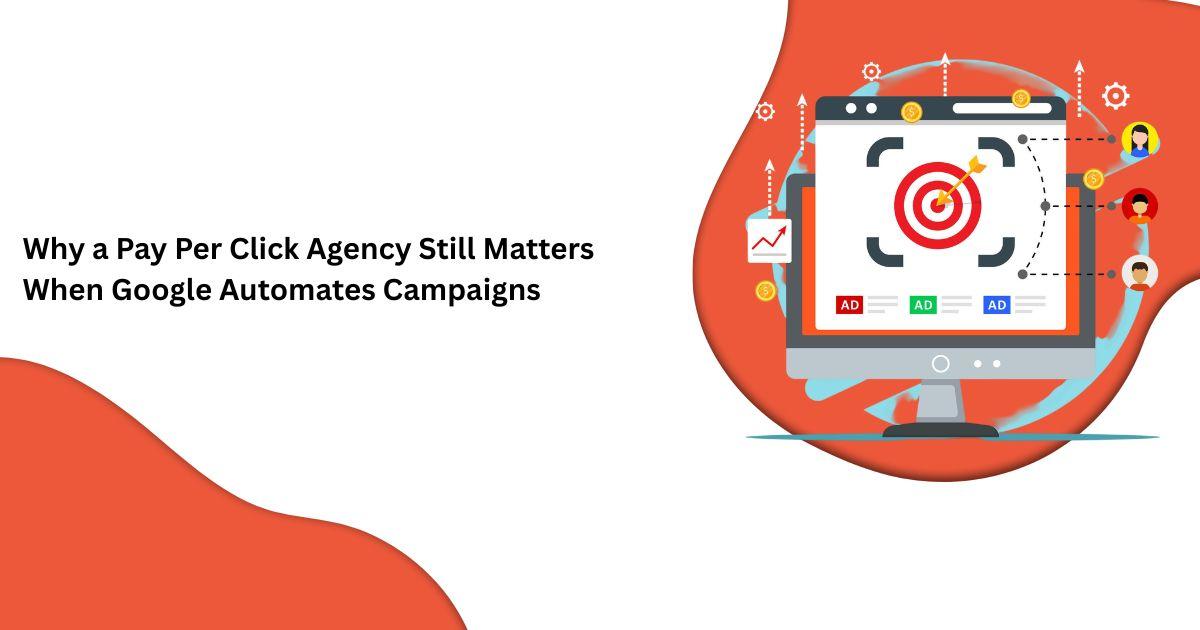
Why a Pay Per Click Agency Still Matters When Google Automates Campaigns
Google Ads has changed. And honestly, it has changed a lot.
Campaigns can now use AI to adjust bids, analyze signals, predict conversion potential, and optimize performance at a scale that would be impossible to manage manually. Google's Smart Bidding, for example, can use auction-time signals to optimize bids toward goals such as conversions, target CPA, or return on ad spend.
So naturally, businesses are asking a reasonable question:
If Google is doing so much of the work, do I still need a pay per click agency?
The short answer is yes.
But the reason has changed.
A PPC agency is no longer valuable simply because someone knows where to change a bid or adjust a keyword.
The real value lies in knowing what to automate, what not to automate, what data to trust, what to test, and how to connect advertising performance with actual business goals. Automation can run a campaign. It cannot replace good strategy.
Google Can Automate Bidding. It Can't Run Your Business.
This is probably the most important distinction. Google's AI is extremely good at processing enormous amounts of data and making decisions within the system. It can consider signals such as device, location, time of day, operating system, language, and search context when optimizing bids.
That's incredibly useful. But Google doesn't know your business the way you do. It doesn't automatically know that one type of lead is worth five times more than another.
It doesn't necessarily understand which customers become long-term clients. It doesn't know that your sales team struggles to close a certain type of inquiry.
And it can't decide whether your campaign is attracting the right customers simply because the conversion number looks good. That's where strategy comes in. A good pay per click agency looks beyond what the platform is doing and asks whether those actions make commercial sense.
Automation Is a Tool, Not a Strategy
There's a common misconception that automation means you can launch a campaign, turn on Smart Bidding, and leave Google to handle everything.
That is where things can go wrong. Automation works from the information it receives. If your conversion tracking is poor, the system is learning from poor data.
If the wrong actions are marked as conversions, Google may optimize toward the wrong outcome. If your landing page is weak, increasing traffic won't magically fix it.
If your targeting is too broad for your business, automation may simply help you spend your budget more efficiently on the wrong audience.
Google itself notes that Smart Bidding relies on conversion tracking and historical conversion data to optimize effectively.
In other words:
Automation can optimize the machine.Someone still needs to make sure the machine is pointed in the right direction.
A PPC Agency Starts With the Right Goal
One of the easiest ways to waste an advertising budget is to start with the campaign instead of the objective.
Do you want:
- More leads?
- More sales?
- Phone calls?
- Website enquiries?
- Bookings?
- E-commerce revenue?
- A specific return on ad spend?
These aren't the same goal.
Google provides different automated bidding approaches for different objectives, including maximizing conversions, target CPA, maximizing conversion value, and target ROAS.
But choosing the right goal still requires business understanding. A PPC agency can help connect the advertising objective to the commercial objective.
Because getting 100 cheap leads isn't necessarily better than getting 20 qualified leads that actually turn into customers. That's the difference between optimizing for platform performance and optimizing for business performance.
Keyword Strategy Still Matters
Automation has made keyword management more sophisticated, but keywords haven't suddenly become irrelevant.
Search intent still matters.
Consider the difference between:
“best digital marketing strategies”
and
“digital marketing agency Dubai.”
The first search may come from someone researching. The second could come from someone actively looking for a service provider. Those users have different intentions. A good PPC strategy understands this difference.
It identifies high-value search themes, separates different types of intent, builds relevant campaign structures, and makes sure advertising messages match what people are actually searching for.
Automation can help Google respond to search behaviour. But someone still needs to decide what behaviour is worth pursuing.
Negative Keywords Still Protect Your Budget
This is one of the less glamorous parts of PPC, but it matters. Not every search related to your keyword is a valuable search. Imagine you're advertising a premium service.
Your ad may appear for searches from people looking for:
- Free services
- Jobs
- Courses
- Tutorials
- DIY solutions
- Cheap alternatives
- Completely different products
You don't want to pay for every one of those clicks. Regular search-term analysis helps identify irrelevant traffic and opportunities for negative keywords.
This is exactly the kind of ongoing work that can get overlooked when businesses assume automation means “hands-off.” AI can help process data. A PPC professional needs to interpret it.
Ad Copy Still Needs Human Thinking
Google can automate parts of the ad creation and delivery process. But your customers are still human.
They respond to messaging. They notice differences between generic advertising and an offer that actually speaks to their problem.
Think about two ads. One says:
“Professional Digital Marketing Services. Contact Us Today.”
The other says:
“Turn More Search Traffic Into Qualified Leads With a Data-Driven Digital Strategy.”
Which one gives you a stronger reason to click?
Good PPC advertising isn't just about inserting keywords into headlines.
It's about understanding:
- What does the customer want?
- What problem are they trying to solve?
- What makes this offer different?
- Why should they trust this business?
That requires creativity, positioning, testing, and a strong understanding of the target audience.
Landing Pages Can Make or Break PPC
Here's something worth remembering:
- A great ad cannot rescue a bad landing page.
- You can target the right audience.
- You can choose valuable keywords.
- You can write compelling ads.
- And still lose the conversion when the visitor reaches your website.
- Maybe the page loads slowly.
- Maybe the headline doesn't match the ad.
- Maybe the offer isn't clear.
- Maybe there are too many distractions.
- Maybe the form is too long.
- Maybe there is no strong reason to take action.
A professional PPC strategy therefore needs to consider the entire journey:
Search → Ad → Landing Page → Action → Conversion
A pay per click agency should not focus only on what happens inside Google Ads. The experience after the click matters just as much.
Conversion Tracking Is More Important Than Ever
If Google is using AI to optimize toward conversions, then the quality of your conversion data becomes extremely important. Think about it this way.
You're telling the system:
“Find me more people like the ones who completed this action.”
But what if that action isn't actually valuable?
For example, a form submission might be counted as a conversion even when most submissions are spam, poor-quality enquiries, or people outside your service area. Google may then try to find more people who behave similarly.
That can create a frustrating cycle.Good PPC management starts with asking:
What actually counts as a valuable conversion for this business?
That could be a qualified lead, completed purchase, booked appointment, phone call, or another meaningful action. Better data gives automation a better foundation.
A PPC Agency Looks at the Numbers Behind the Numbers
A dashboard might show:
Clicks: Up
Conversions: Up
Cost per conversion: Down
Looks great.
But what if sales are down?
That's when you need someone to investigate.
- Maybe lead quality has dropped.
- Maybe the sales team isn't following up quickly enough.
- Maybe a new competitor entered the market.
- Maybe the average order value has changed.
- Maybe one campaign is generating most of the conversions but very little revenue.
This is why PPC reporting shouldn't stop at impressions, clicks, and conversions. A strong PPC strategy connects advertising data with business data wherever possible.
Because the ultimate question isn't:
“How many conversions did Google generate?”
It's:
“How much valuable business did our advertising generate?”
Automation Makes Testing More Important, Not Less
When Google handles more of the technical work, human attention can shift toward higher-value decisions. That means testing.
Different:
- Offers
- Headlines
- Landing pages
- Audiences
- Campaign structures
- Conversion goals
- Messages
- Calls to action
You don't need to guess what customers prefer. You can test it. The data tells you what deserves more attention.
And when something doesn't work?
You learn from it. That mindset is particularly important in competitive markets like Dubai, where businesses may be competing for the same high-intent searches and audiences.
Budget Management Still Requires Judgment
Automation doesn't mean every campaign deserves unlimited freedom. Businesses still have budgets. And every business has different economics.
A company selling a AED 10,000 service can approach acquisition costs very differently from a company selling a AED 100 product.
A good PPC strategy considers:
Customer value → acceptable acquisition cost → conversion rate → campaign economics
This is where a PPC agency can bring a valuable outside perspective.
Instead of simply asking:
“Can we get more conversions?”
The better question becomes:
“Can we get more profitable conversions?”
Those are two very different objectives.
Google Automation Doesn't Understand Every Business Nuance
AI is powerful. But businesses are complicated.
- Maybe your busiest sales season is approaching.
- Maybe a particular service is temporarily unavailable.
- Maybe margins have changed.
- Maybe you want to enter a new Dubai market.
- Maybe one product is strategically more important than another.
- Maybe your business has stopped accepting a particular type of customer.
These are business decisions. They aren't simply bidding signals. A PPC professional can bring those real-world considerations into campaign planning and optimization. That human context matters.
So, Does Google Automation Make PPC Agencies Less Important?
In some ways, it makes them more important, but for different reasons. The old PPC model was heavily focused on manual campaign management.
- Adjusting bids.
- Changing keyword bids.
- Checking positions.
- Making repetitive account changes.
- Automation has reduced the need for some of that manual work.
That's a good thing. It means PPC professionals can spend more time on the things that actually require judgment:
- Strategy.
- Research.
- Creative testing.
- Audience understanding.
- Conversion tracking.
- Landing page optimization.
- Budget allocation.
- Performance analysis.
- Business alignment.
Google's own guidance encourages advertisers to use accurate conversion data, choose the right bidding strategy, test approaches, and evaluate performance rather than simply turning automation on and walking away.
The Future of PPC Isn't Humans vs AI
It's humans using AI well. That's the real shift. The best PPC campaigns won't be built by someone manually controlling every bid.
And they won't be built by someone handing everything over to Google and hoping for the best. They'll be built by combining both strengths.
AI handles scale, speed, and complex auction-level decisions. Humans provide strategy, context, creativity, judgment, and business understanding. That's a much more powerful combination.
Final Thoughts
Google Ads automation has made PPC smarter. It has made bidding faster. It can process more signals than a human ever could and make auction-time decisions at an enormous scale.
But automation doesn't eliminate the need for expertise. It changes where that expertise matters. A strong pay per click agency isn't there simply to move numbers around inside an advertising dashboard.
It's there to make sure your advertising has a purpose.
To identify the right opportunities.
To understand your customers.
To build the right campaign structure.
To monitor search behaviour.
To improve messaging.
To protect your budget.
To validate conversion data.
And, most importantly, to connect advertising performance with actual business growth.
So don't ask:
“Can Google run my PPC campaign automatically?”
It can automate a lot.
Ask the more important question:
“Who is making sure the automation is working toward the right business outcome?”
That's where a good PPC agency still earns its place.
FAQs
1. What does a pay per click agency do?
A PPC agency creates, manages, and optimizes paid advertising campaigns across platforms like Google Ads to increase qualified traffic, leads, and sales.
2. Does Google Ads automation replace PPC experts?
No. Automation improves campaign efficiency, but experienced professionals are still needed to develop strategy, optimize budgets, improve landing pages, and align campaigns with business goals.
3. Why are negative keywords important?
Negative keywords prevent your ads from appearing in irrelevant searches, reducing wasted spend and improving campaign efficiency.
4. What is Performance Max?
Performance Max is Google's AI-powered campaign type that uses machine learning to display ads across Search, Display, YouTube, Gmail, Maps, and Discover using one campaign.
5. How often should PPC campaigns be optimized?
Campaigns should be monitored regularly and optimized continuously based on performance data, search trends, conversions, and budget efficiency.
6. Can PPC improve results quickly?
Yes. Unlike SEO, PPC can generate targeted traffic almost immediately after campaigns are launched, although continuous optimization is essential for long-term profitability.
7. Why is landing page optimization important for PPC?
A well-designed landing page improves user experience, increases conversion rates, lowers acquisition costs, and maximizes return on advertising investment.
8. Why choose Quick Digitals as your pay per click agency?
Quick Digitals combines AI-powered campaign automation with expert PPC management, strategic planning, keyword research, conversion optimization, transparent reporting, and continuous performance improvements to help businesses achieve stronger ROI and sustainable growth.
Categories
Recent Post
 September 30, 2026
What the Best Digital Marketing Company Dubai Actually Does
 September 28, 2026
SEO UAE Beyond Keywords Building a Stronger Search Presence
 September 25, 2026
How a PPC Management Agency Dubai Reduces Wasted Ad Spend
 September 23, 2026
